Day Two
A Week on the George Parks Highway

33 Miles. Willow to Montana Creek
I might be taking guitar lessons for all the wrong reasons. I mean, I want to learn to play well— although that goal seems so distant that it hardly seems real. But the joy of the lessons is that I get to listen. I’ll be struggling through a riff, and I’m off the beat, or I’m trying to understand how a pentatonic scale gloves into a chord. So the teacher plays a flash of rhythm and blues, a little nano-concert just for me. And I’m transfixed, dumbstruck, like someone just explained the cracking point of viscous liquids.
I get a little over-enthusiastic sometimes.
I quickly pull myself together and make my fingers mumble through what he just played--but in stop motion.
One time he had a gig coming up, and I made the mistake of asking him if it was going to be fun. He said, sure. But he pointed out that it was a job, after all. A great job, but it’s still work. You show up. You do the job. You hope you get paid.
I’ve got it easy. I’m retired. I might always be a crappy guitar player. That’s ok. I don’t have to be good. I’d like to get good at it, but I don’t have to. In the meantime, I enjoy the work. It’s not a means to an end. It’s an end--in and of itself.
In other words, it’s an adventure.
Socrates bumps up against the idea of adventure in his dialog with Polus. They’re discussing the concept of power. Is a dictator powerful just because he can have a person executed or exiled? Similarly, is an influencer powerful just because she can convince a group of people to harass and jail others because of the color of their skin. Polus says those are examples of power. Socrates says no. That’s not power. It’s worthy of pity.
His argument is weird. It has to do with means and ends:
It’s a “universal principle that whenever someone does one thing for the sake of another thing, what he wants is not what he’s actually doing, but whatever it is that what he’s doing is a means towards.”
Socrates thinks that to be truly powerful, you have to really want to execute that man. But, he says, the rhetorician doesn’t really want the execution. The execution is only a means to an end.
“We don’t, then, in an unqualified sense, want to slaughter people or exile them from their communities or confiscate their property. We want to do these things only if they’re in our interest, but if they’re not, we don’t want to do them, because, … we want good things.”
He uses the analogy of an entrepreneur who goes on a sea voyage as part of their business. The voyage is difficult, dangerous, even. The entrepreneur doesn’t want to take the voyage, but it’s a necessary means to an end. So how can an entrepreneur be truly powerful when she has to do something she doesn’t want to do?
Socrates doesn’t say this, but it’s a great privilege to experience that dangerous voyage as an adventure. Can we experience a voyage as an adventure and a job? Yes, but not at the same time.
The Lewis and Clark expedition is often characterized as an “adventure.” Maybe it was, for some of the people, some of the time. But two years and four months of backbreaking work, conflict, hunger, blindness, bear attacks—that can’t all be adventure. Mostly, it’s drudgery. In every mind, there’s a mixer with sliding controls. The higher “job” is in the mix, the lower “adventure” sits.
One moment, your trip is just a means to an end. How many more miles do I have to pedal? The next moment, the ends fades, and you’re having an adventure.
My plan is to ride to Fairbanks and take the train back home.
After leaving last night’s undisclosed location, I stopped at a bank ATM for cash, then rode a short 30 miles to the Montana Creek campground….
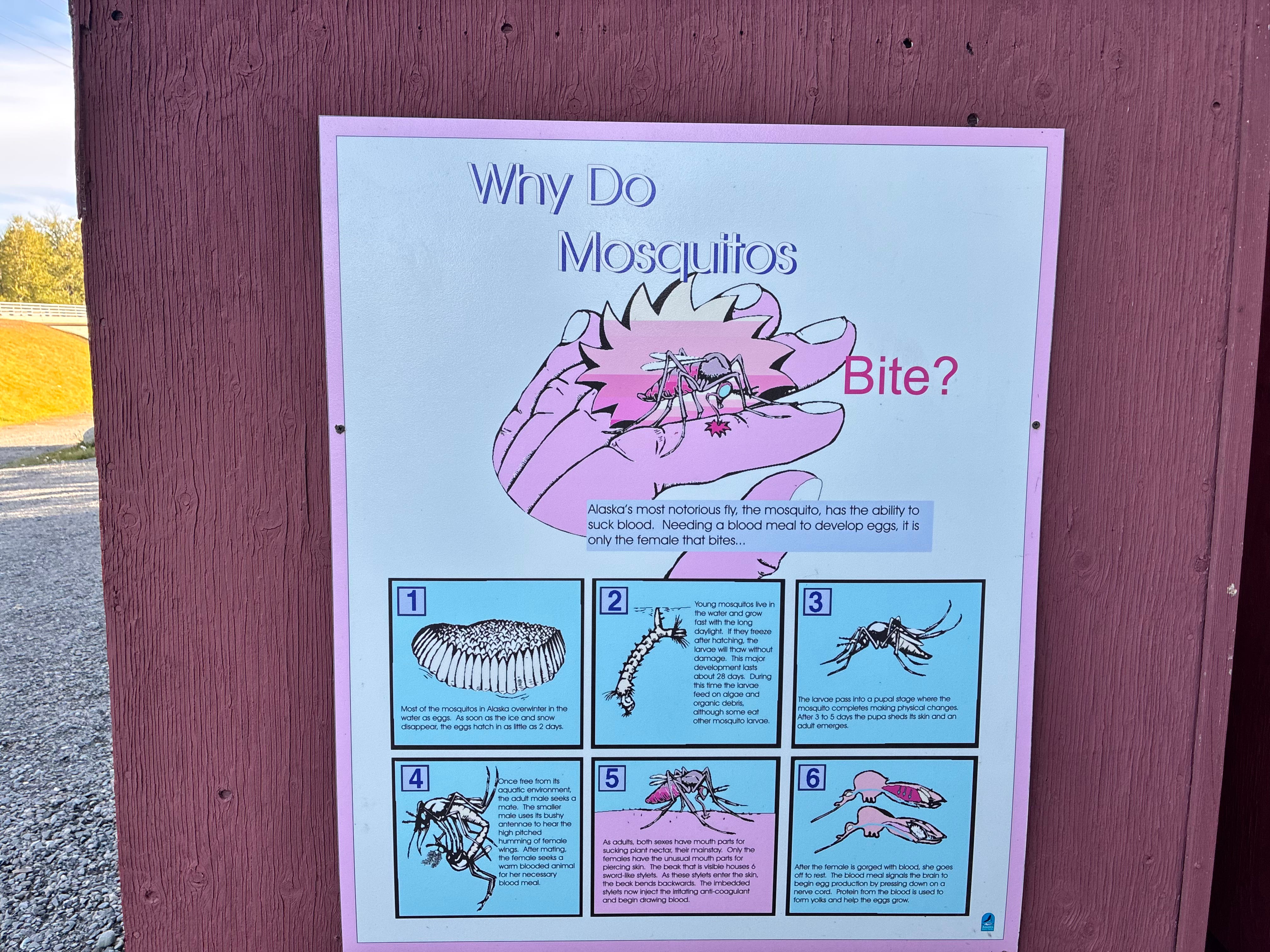
No, the camp host says, there haven’t been any bear incidents. But the mosquitos are awful this year.
I picked the campsite with the most sun, thinking that direct sunlight might discourage the pests. No such luck.
I set up the tent as fast as I can.
Since the bear threat is minimal, I don’t bother stashing my food 200 feet away. But no food will ever go in my tent .
While riding, I carry a small silicone zip-lock bag of snacks in my frame bag. That goes in my bear cannister at night, with the other food, the mosquito repellant, eye drops, toothbrush and toothpaste, and sunscreen. I didn’t bring a stove this trip, so I’m not carrying any food. There are differences of opinion about rather fuel should be stashed in the cannister. I don’t have to think about that this trip.
At night before going to bed, all that has to be stashed in the cannister. I soak a couple of servings of quick-cook oatmeal in a baggie, and replenish the snack bag, then pack the canister so breakfast and the snack bag are on top. Now’s the time for brushing my teeth and using the eye drops, so I can tuck everything safely away.
Simple, right? But somehow, while waving away mosquitoes, I end up packing and repacking the bear canister three times. That’s really frustrating.
This gets better on longer trips. After awhile, packing and unpacking becomes a routine. But this first night is full of missteps and self-recriminations.
But two things redeemed the night for me.
First, something magical happens as I get into my tent: untie my shoes at the door, unzip the inner tent, wiggle my butt into the tent, kick my shoes off outside, but under the fly, and zip the door closed. And right at that moment, just as I get cozy, the first raindrop taps the roof. The timing could not have been better.
Then, the second gift from the heavens: the sound of the train horn. I’m going to be on train, I thought.
I sleep soundly under a gentle rain.
I forgot to include references yesterday. Here are some references for both days;
Plato. 1994. Gorgias. Translated by Robin Waterfield. Oxford: Oxford World Classics.
Severson, Kim . 2026. The Pursuit of Hungriness: 250 Years of American Food Innovation. June 29. https://www.nytimes.com/interactive/2026/06/29/dining/america-250-years-of-food.html.
Subrahmanyam, Rohini. 2026. We Know Simple Fluids Can Flow. Turns Out, Some Can Fracture. July 10. Accessed July 2026. https://www.quantamagazine.org/we-know-simple-fluids-can-flow-turns-out-some-can-fracture-20260710/?mc_cid=8bb5409531&mc_eid=65c6cc1f7d.
Chopin:
Thanks for the Chopin! Was that the piece your friend played? Beautiful, in any case.
Thanks for sharing your adventure and your thoughts with us!