Day Three
A Week on the Parks Highway

Day 3 54 miles
[An Undisclosed Location Near Byer’s Lake]
It’s dumb to call someone dumb just because they’re wrong.
This is something I say all the time, and all the time almost no one agrees with me. So I keep saying it anyway.
If intelligence is the cognitive lifting it takes to claw your way to a conclusion, then intelligence gets it wrong all the time. Look at me, a lazy thinker, not-too-bright, a little dull. But I don’t rely on Ivermectin as a vaccine against COVID. I’m right about that, but am I more intelligent than the person who goes that route?
Look at the cognitive work I did to get here:
1) There’s clear evidence that death rates go down when people use real vaccines;
2) I admire the system of careful, peer-reviewed work that produced the vaccine—even though I recognize its imperfections, and
3) Horse worms. YUCK!
The Ivermectin influencer does so much more work. Fifty arguments where I have three. The holes in their arguments are big—but they have so many arguments. You’ve got to be really smart to tackle them all!
As we’ve already established, I’m not that smart.
But I’m right.
And your circumstances change the workload. Let’s think of cognitive work as a road you have to travel to get from your house to the truth.
Take climate change. I know there are human causes behind the heat waves blasting Europe, and I know they are connected to the burning of fossil fuels.
We all have a road we must travel to arrive at that conclusion. Are some of our roads longer than others? I think so.
An Exxon executive put her kids through college, remodeled a home, read The Magic Mountain on the plane to Davos. Fossil fuels made all that possible. All that goodness at the top of the mind. That’s a longer road to travel. Processing that information takes more cognitive and emotional labor if there’s an Exxon logo on your paycheck1.
How do we draw our lives to scale in the map of the world in our head?
So, if I’m right about any of this, it’s has very little to do with individual intelligence.
What we know about climate change—what we know about almost everything—is the result of a globalized intelligence, constellations of data collected from around the world.
Longitude has nothing to do with climate change, but we could never have figured out climate change if we hadn’t figured out longitude. Of course, if we hadn’t figured out longitude, we may never have had to worry about climate change.
Mapping the world was a long, laborious process. You might already know this story. There’s a great summary at the Royal Observatory Greenwich website.
Getting latitude was easy– the horizontal lines parallel to the equator. But for longitiude, mapmakers needed to calculate the distance of the earth from the moon at a certain time from two different locations. They didn’t have the tools. They needed better clocks, They needed better instruments. They needed better star charts.
John Flamsteed started a process that ended up taking 91 years. He pulled data from sailors at ports all over the world, comparing it with the subpar star charts then in existence. Of course, it’s all tied together with the European drive to dominate the world, but I can’t help but marvel at the process, the fact that people were able to collect thousands of bits of data from all over the world, 10,000 thoughts in search of a thinker.
Each observation is separate from the others. No data point knows the picture it is painting. That’s why I think our world is so different from Socrates’ world—in ways we can hardly imagine. When he talks about rhetoricians, or influencers, he’s talking about individuals at a council making speeches to each other. He’s not talking about 4,000 yard signs, 8,000 radio spots, 100,000 Coca-Cola logos, Russian and Chinese and Iranian bot farms all trying to flatter us with familiarity.
In the dialog, persuaders and dictators share certain characteristics. They act justly or unjustly. They start wars, kill opponents, confiscate property. Polus calls that enviable. Socrates says it’s pitiable, especially when the actions are unjust. If happiness is good, then the influencer can’t be happy while doing wrong.
Donald Trump, for all his gold-plated toilet seats, his immunity from the rule of law, his ability to arrest opponents, bomb fishing boats, or murder an immigrant in Houston with the flick of a pen—for all that, Socrates thinks he can’t be happy. Polis, on the other hand, thinks all that influence and power would make a person happy no matter how evil they might be.
I grew up in a Christian Science household. We prayed every day that we wouldn’t “influence people erroneously.” I recited that prayer as a child for years without knowing what “erroneous” meant. I mouthed the word, but in my mind, I edited it out.
So I spent much of my childhood praying not to be influential at all.
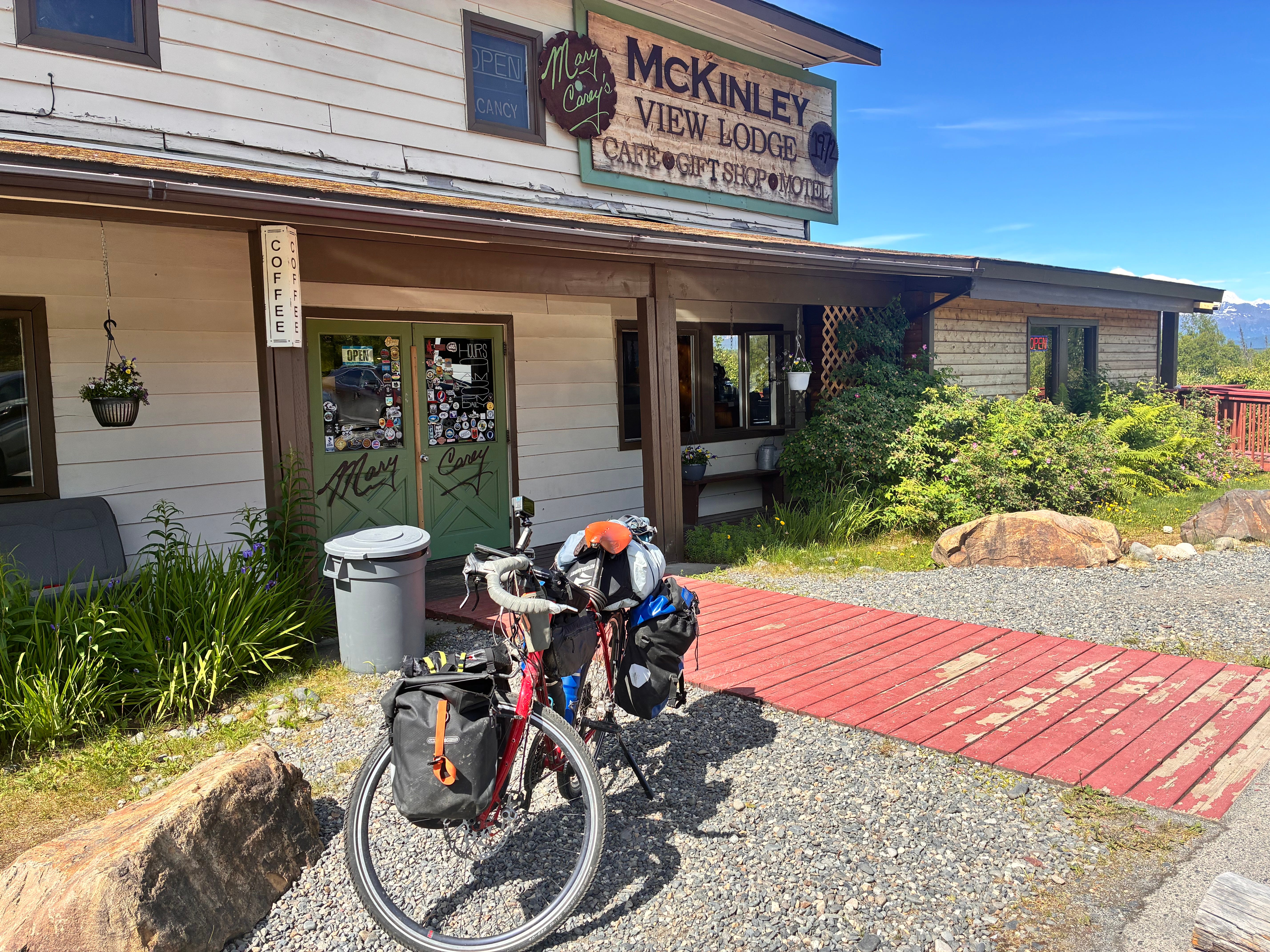
I met some other bikers on the Parks Highway. Three recent college graduates from California. They passed me by a couple of hours after Trapper Creek, but I saw them again at Mary Carey’s lodge near Byer’s Creek. I think they were just getting something to drink and some snacks. I ordered a burger and fries and shared the fries.
Someone asked me for advice as an Alaskan who has ridden these parts. I really wanted to have something good to say. Nothing. I muttered something about “checklist tourism.” Some tourists come to Alaska with a list of things they want to see: they want to see Mount Denali. They want to see moose, caribou, bears, wolves. If they don’t see any of that, their trip won’t be satisfying. Don’t do that, I said. This is Alaska, one of the most beautiful places in the world. Accept that.
Great advice if you’re in a car. But a bicycle tourist already understands that. They were very polite, but I felt I failed them somehow.
Oh! I know! Bear spray! I had an extra can of bear spray I could have given them if they didn’t have any. But they were already gone. They were smart, though. I bet they had some.
https://www.royalobservatorygreenwich.org/articles.php?article=1290
Let’s just pretend that people still get paychecks.
Ivermectin has been approved for human use since 1987 as an antiparasitic. In the US, we don't have much use for antiparasitics. The rest of the world does.
'...we conducted a comprehensive review of the scientific literature on the use of ivermectin as an antiparasitic agent worldwide. The objective of this study is to conduct a comprehensive literature review of the use of ivermectin in the treatment of parasitic infections, including its efficacy and safety, with a specific focus on the prevalence of parasitic infections in Peru and the potential for the use of ivermectin in mass treatment campaigns.'
Title:
Evidence-based indications for ivermectin in parasitic diseases: An integrated approach to context and challenges in Peru
https://pmc.ncbi.nlm.nih.gov/articles/PMC10507222/