Day Five
A Week on the Parks Highway

25 miles from East Fork Chulitna River to Cantwell
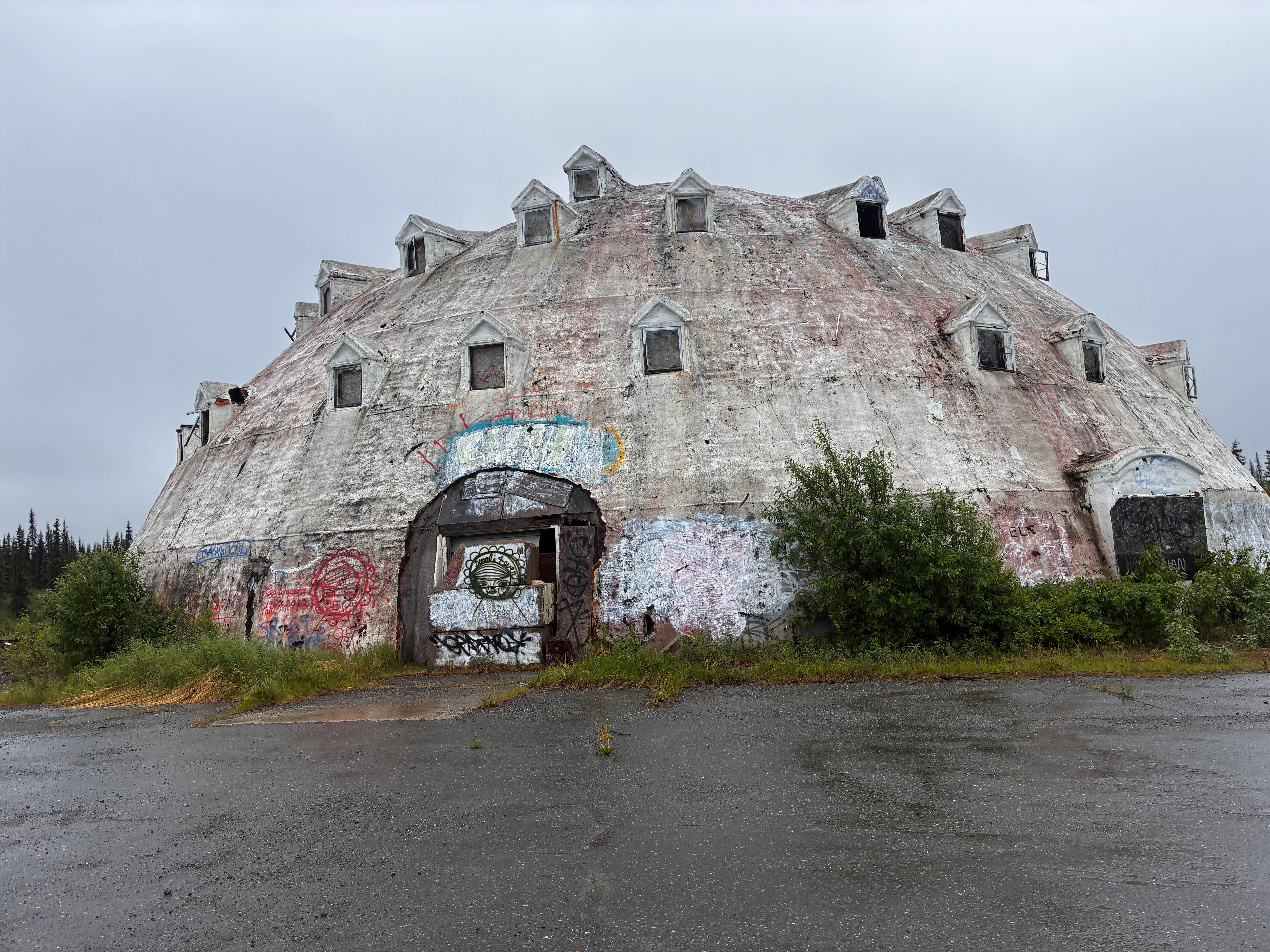
Day Five
Two difficult days on the bicycle. Thirst. Weakness. Mosquitoes. Whiny legs. But I didn’t wake up demoralized. I had everything I wanted. There was never a moment when I wished I was someplace else, home in my favorite chair, binge-watching some Korean historical soap opera. This is where I want to be. This is what I want to be doing. Breathing the unboxed air, solving the solvable problems.
The mind needs difficulty.
Researchers used to think that serif fonts—letters with horizontal lines carved into their designs—were more “readable.” Maybe they still do. I’m not sure. There’s some thought that the rules change from screen to print.
But while researchers argued about what made writing more readable, others wondered if readability was such a great idea. Do we really want reading to be frictionless? Friction helps us remember, helps us learn.
My guitar teacher wants me to learn the notes on the bottom two strings. The idea is, if I know those notes, there are patterns, finger shapes I can use to orient myself to the rest of the fretboard.
In this context, knowing means not having to think.
Each fret divides the line at a different length, each note with its own name-- actually, each note has two names. There’s a letter name and numerical name. The letter name stays the same. The number changes. The E string at the third fret is always G. But if you’re playing the key of G, then E string at the third fret is 1 in the scale. Change the key, and the number changes.
For some reason, G is easy for me. Say “G on the E String” and I’m already there, finger on the third fret before you’re finished speaking. Say “C” and I’m there almost as quickly. But I’m slow on the “A.” My mind doesn’t go there first. It goes to the G string, then calculates where the A string is in relation to the G.
The G scale was the first scale I learned to play on the guitar. The path is easy to follow.
Finding C is quick now, because it used to be slow. On the piano, it’s easy to recognize C because the arrangement of black and white keys is different. There’s no black key—no half note between B and C. The guitar doesn’t give that visual cue.
Learning the line is not linear.
Lewis and Clark is an American story. Henry David Thoreau is another American story. They are so different, almost opposite. One story is about adventure far afield. Anothrer story is about adventure at home. Maybe an American psyche sits in tension between these two poles.
Thoreau spent his whole life studying one area, diving deeply, noticing the differences from season to season, year to year, reading journals from early explorers, noting that lynx no longer dominate in the area as they had a hundred years before.
His first book, A Week on the Concord and Merrimack Rivers chronicled a trip that started near his home. His more famous second book focused even closer to home.
Lewis and Clark, on the other hand, were travelers. The whole two-and-a-half-year experience was defined by movement. Even the long winter months at Wood River, Mandan and Clatsop were impatient pauses.
That’s not to say that Lewis and Clark weren’t great naturalists. Clark’s observations at the Spirit Mounds near Vermillion, South Dakota could have been written by Thoreau. But some learning takes time.
In fact, contemporary readers correctly mock Thoreau for bragging about his self-reliance in a cabin on Waldon Pond-- when he apparently sent his laundry home to his mother.
Thoreau lived in greater comfort than Lewis and Clark, but Thoreau’s attitude about learning feels more authentic. The earlier expedition was grab-and-go learning. Collect specimens. Name “new” species and rivers, jot down the experiences. And go.
I fall somewhere in-between the two poles. I like the bragging rights that 23 states gives me.
But I love returning, digging deeper, asking new questions.
I’ve ridden this section of the Parks highway a half dozen times. Each time the weather’s different. Each time the people I meet are different. Each time I am different.
How many times have I passed by this landmark?
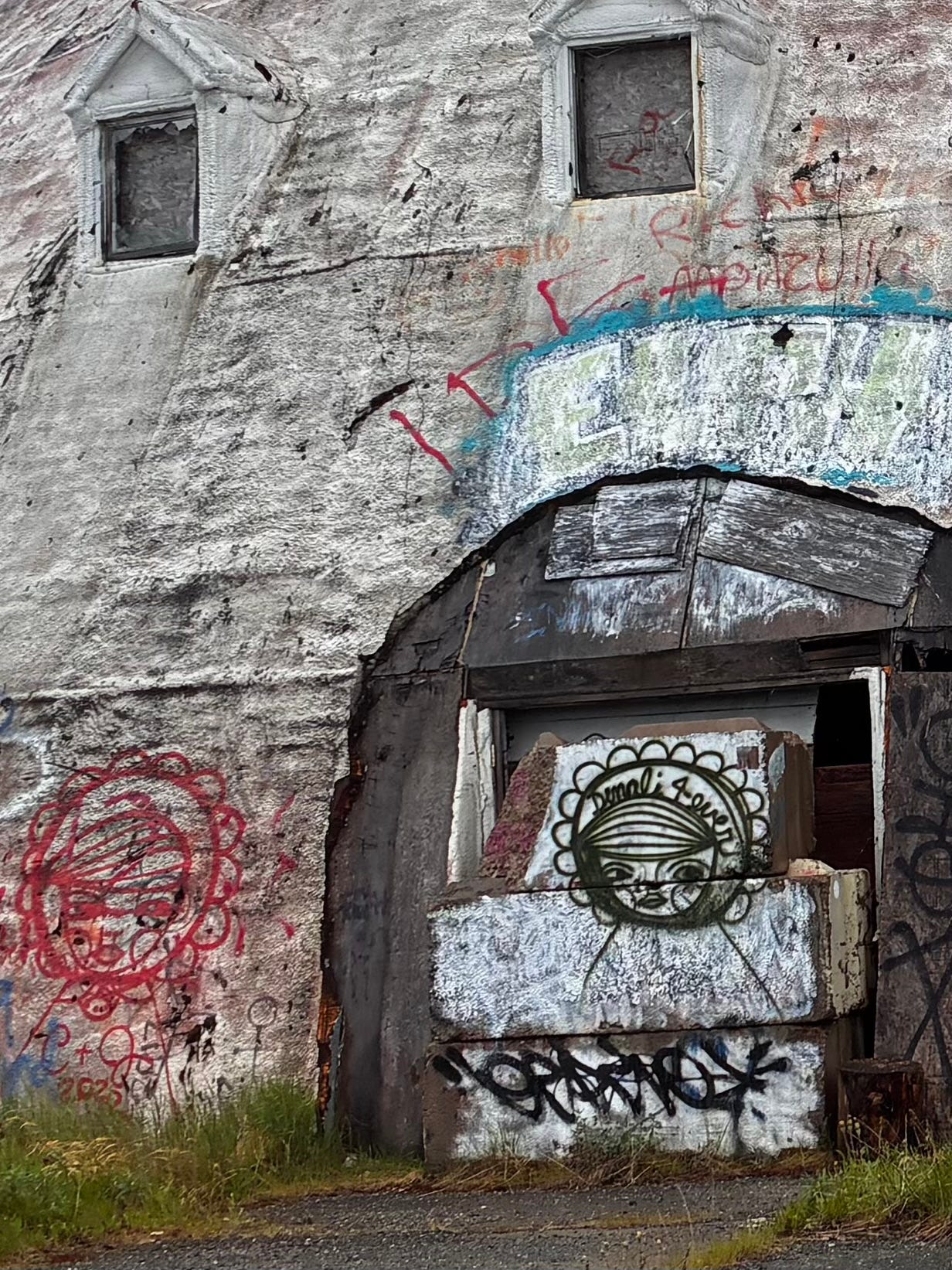
I’ve never seen it quite like this, on a rainy day, the deteriorating foam, the colors coming through, the defiant, sad expression on the graffiti. I wish I could meet the artist who left this mark.
--
It’s a shorter ride today. The rain doesn’t bother me. I meet another biker at Jam Jams, enjoy some warm Jamaican lunch. He moves on to Denali. I head to the RV campground.
The managers of this campground are some of the friendliest people I’ve met. They’re having a birthday party for one of their daughters. They’re smoking a pork roast, and they invite me to join them. The rain stops in time. Don’t be shy, the grill master says. There’s plenty. And I obey him. There’s pie. There’s homemade ice cream. There’s good cheer.
Later, a grizzly bear ambles through the campground. That wouldn’t worry me too much, but the camp host was somber. They said this bear was different. He showed absolutely no fear of humans. There was an old camper on site. They helped me move my sleeping bag and food into the camper for the night.
I sleep well, and am in good spirits in the morning, but I decide to cut the trip short. The last ride to Fairbanks looks hard. The map shows two big hills and about 60 miles from Nenana. The plan had been to ride to Fairbanks, then take the train back the next day. I decided to ride to Healy and jump onto the same train at Denali Park.
Being able to flexibly change a plan shows, I think, that you were actually living in the moment, not sticking to a pre-set schedule! Good work!
Do we 'think too much', or 'not work hard enough', you and I?
I am reminded of RWE: 'To be yourself in a world that is constantly trying to make you something else is the greatest accomplishment.'
Rejoice in being yourself; thank you for sharing.